The view
Sanctuary of Truth across the bay
The carved wooden sanctuary seen from the fire show's tables: who built it, why it is unfinished, what its halls show, and the port lights beside it at night.
Book a seat by the fire ↗Quick answer
The dark silhouette across the water from the fire show's tables is the Sanctuary of Truth, an unfinished museum in Pattaya made wholly of wood, whose design borrows from the Ayutthaya Kingdom and from Hindu and Buddhist thought. Building started in 1981 and goes on today; the tallest spire is 105 metres high. After dark, the lights of Laem Chabang, the port city up the coast, join the view.
What you are looking at
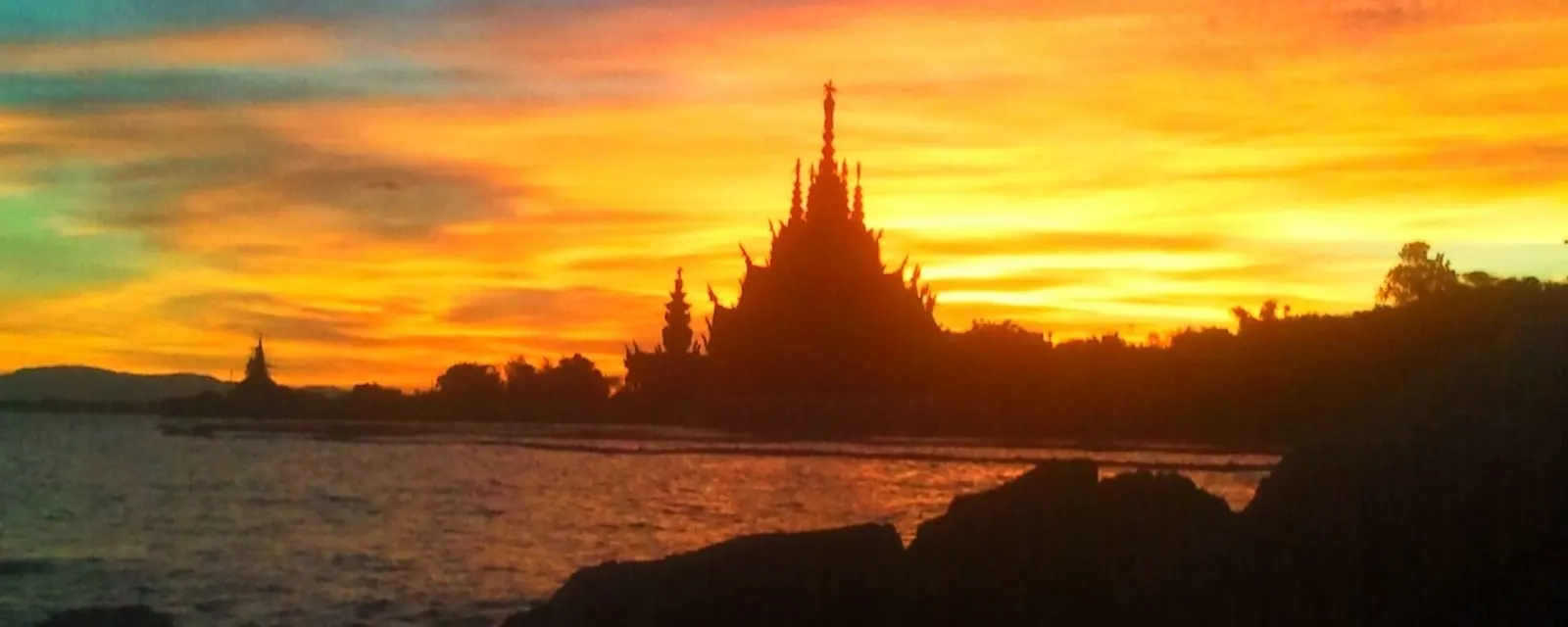
From the beach the sanctuary reads as a cluster of pointed spires on the shore, black against the sky once the sun has gone. It is a museum, designed by the Thai businessman Lek Viriyaphan, and a hybrid of temple and castle. The building is made entirely of wood and contains only wood-carved idols and sculptures. Sitting on a bamboo seat with dinner in front of you, it gives the evening a skyline that is unmistakably Pattaya.
Built of wood, and still being built
Construction started in 1981 and is still under way; visitors are allowed inside wearing hard hats. The structure uses several kinds of wood, including Xylia xylocarpa, takien, panchaat and teak, which gives different parts of the building different textures. Takien was used for the main post and is expected to last for 600 years. The site covers 13 hectares, the interior about 2,115 square metres, and the central spire rises 105 metres.
What the halls show
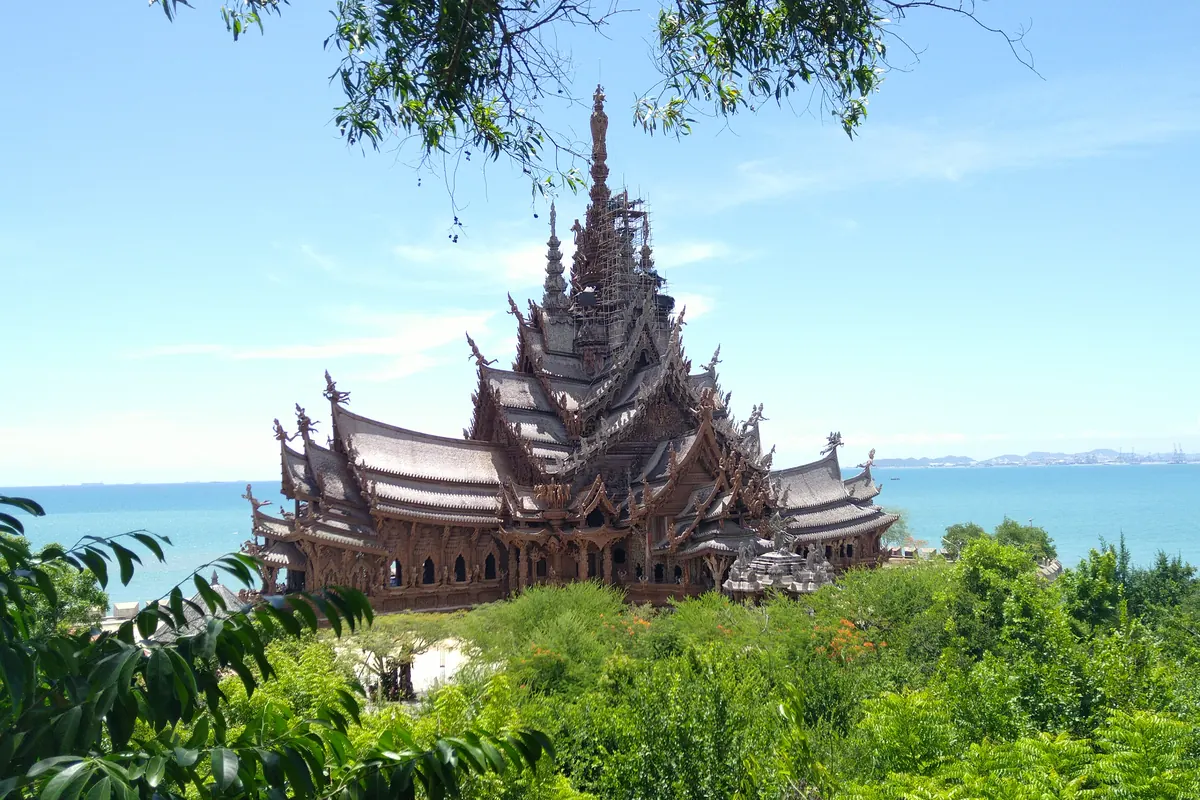
The rooftop carries a four-faced statue of Brahma, the Hindu creator god, alongside Ganesha. The northern hall features Guanyin and sculptures on the wisdom of emancipation; the southern hall takes the sun, moon and planets as its theme; the western hall shows the classical elements, earth, water, wind and fire, with Brahma, Vishnu and Shiva; and the eastern hall features family. The whole design sets out to show eastern religious ideas and the cycle of life.
Visiting by day
If the silhouette makes you curious, the sanctuary is open to visitors during construction, and the site offers more than the building: Thai boat trips, horse-carriage rides, a restaurant serving Thai and halal food, and an area where you can watch wood carvers at work. It makes a natural daytime companion to an evening at the fire show, since you will already know its outline from the beach. Go in daylight to see the carving properly; from the sand at night you get the shape, from inside you get the detail. Wear shoes you can walk in, as the building is still a construction site, and allow time for the grounds as well as the halls.
The lights of Laem Chabang
After dark, the other lights across the water belong to Laem Chabang, a port city municipality in Si Racha and Bang Lamung districts of Chonburi province. The city grew up around a deep-sea port whose container terminal was completed in 1991, and it is a major stop on the coastal highway linking Pattaya and Bangkok. It is a working harbour rather than a sight, but at night its glow makes a backdrop for the flames on the sand. Between the two, sanctuary and port, you have the whole northern horizon of the evening: one carved by hand in wood over decades, the other a deep-sea container port.
Read next: Pattaya beach fire show: worth it?
Pattaya before the hotels
The city around you was a fishing village until the 1960s. Visitors started coming during the Vietnam War, first as American servicemen on rest and recreation leave, and Pattaya was granted city status in 1978. Its name is said to trace back to Phraya Tak, later King Taksin, whose army met a local force here before the fall of Ayutthaya in 1767; the place became known as Thap Phraya, later Phatthaya, which also names a seasonal wind from the south-west.
Sources